Story
30 January 2025
The power of a new beginning: how NGO 'Artemida' helps women break the cycle of domestic violence
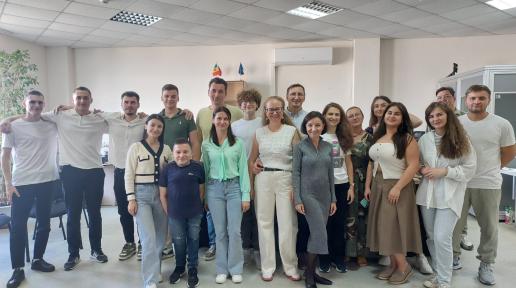
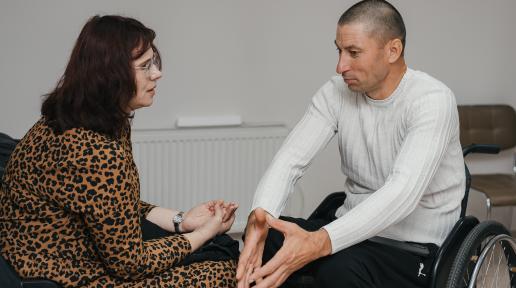
Just in the past year, with support from the United Nations Population Fund (UNFPA) and the United Kingdom, "Artemida" managed to provide cash assistance to 224 women, including those from the local community and Ukrainian refugees. Additionally, over 8,600 women have benefited from informational services, and around 4,900 girls and women have received psychological help and emotional support.As part of its partnership with UNFPA, "Artemida" is carrying out various activities in 13 districts in the northern region (Florești, Glodeni, Fălești, Sîngerei, Șoldănești, Soroca, Rezina, Ocnița, Rîșcani, Drochia, Briceni, Dondușeni, and Edineț) and four districts in the southern region (Cahul, Cantemir, Taraclia, and Leova). This is all done through three mobile teams, three static teams, and the team responsible for providing financial assistance.Field work of the mobile teamsEvery morning, the mobile teams and the team responsible for providing financial assistance from the association travel to various locations across the country to offer necessary support to women in these communities. The mobile teams were established in 2022 by UNFPA, in partnership with the NGO "Artemida" and in collaboration with the Ministry of Labor and Social Protection, as a response to the refugee crisis. Since then, they have been delivering qualified services to refugees and host families.Each team includes social workers and psychologists. The mission of the mobile teams is to inform girls and women about gender-based violence, domestic violence, reproductive health, and specialized services for preventing and combating violence. Additionally, women can access psychological and emotional support through these teams.“After the informational sessions, we always stay for at least 20 minutes because women who didn’t feel comfortable asking certain questions publicly come back. We provide them with the information they need but were hesitant to ask about,” says Liliana Juc, a psychologist with the NGO "Artemida."On the other hand, the "Artemida" team is responsible for case management and monitoring for victims of domestic violence and refugee women in need of assistance, including financial aid. The social workers on the financial assistance team create individualized intervention plans tailored to the victims' specific needs and requirements. These plans include informational support, legal assistance, medical and psychological care, as well as cash assistance provided for three months. This way, team members act as liaisons between women in need and the institutions that can provide the required support.“Once the objectives of the individualized plan are met, the case is closed. However, we can revisit it anytime if the person needs further assistance,” explains Mariana Zaporojan, a social worker at "Artemida."Meetings with financial aid beneficiaries are conducted individually in the Safe Space inside the specially equipped vehicle that travels to their location. “Depending on the women’s schedules, we can counsel up to six people per day,” adds Mariana Zaporojan.The "Ariadna" temporary shelter centerThe NGO "Artemida" also manages the "Ariadna" Assistance and Counseling Center for survivors of domestic violence, founded in 2006 in Drochia. The center provides refuge for women and children at high risk, where their safety and well-being are jeopardized if they remain in a violent home environment. When legal protection measures fail to ensure the safety of survivors of domestic and gender-based violence, they are temporarily housed at "Ariadna."The stay at the center lasts three months but can be extended up to six months if risks persist. The center has the capacity to host 24 individuals, including women and their children, simultaneously. It offers private rooms, including accommodations for individuals with disabilities, multiple bathrooms, a counseling room, and a shared kitchen.“When a woman is placed in the center, a bank account is opened for her. Each month, state funds are transferred to this account to cover food and hygiene expenses during her stay,” explains Ina Danilciuc, a social worker at the "Ariadna" center.In 2023 alone, 15 women and 26 children benefited from temporary shelter at "Ariadna."Real stories of resilienceBelow are the real stories of three women who successfully broke the cycle of violence and started new lives, supported by the "Artemida" team with assistance from the United Nations Population Fund (UNFPA) in Moldova. These women received psychological support, legal aid, social and financial assistance, informational services, and care for their children.Maria*, 40 years oldMaria and her former husband were married for 15 years, during which she endured multiple acts of violence. “I was in a foreign village, with four small children, not knowing where to go, so I endured it. His family worked in agriculture and had connections in the police. What could I prove? Who would listen to me? No one would protect me,” Maria recalls.Her ex-husband was violent not only towards her but also towards their four children. “We have a son and three daughters together. We were all beaten together, hugging each other and crying. I remember once he beat me because I didn’t answer the phone while I was working in his father’s field. He took a cable and hit me and the children, who had accidentally put the phone on silent. I tried to shield the children with my body and was hit so hard I couldn’t lie on my back for a month.”For over four years, Maria’s ex-husband has been in Poland, where he owns a business. A year ago, he invited Maria to join him with their four children. “I sold almost everything in the house to cover some of his debts and went to Poland. Shortly after, I found out he had a mistress. We argued. He threatened to kill me multiple times and physically assaulted me,” Maria recounts.At that point, Maria decided to turn to the Polish police. Her husband was placed under the supervision of the police and social services. “When I told him I wanted to return to Moldova with the children, he called the police to deport me, claiming my stay had expired. But I already had permission to leave Poland. One day, I took the children to school, and while he was asleep, I retrieved my documents, which he had hidden. That same day, while he was away with his mistress, I quickly packed our belongings, picked up the children from school, and left for Moldova.”Upon returning to Moldova, Maria and her children went to her hometown. “My mother’s neighbor allowed me to live temporarily in her deceased parents’ house. I made some repairs. Later, the daughter of a friend introduced me to a charitable organization. They helped me buy a larger house with better conditions.”Maria met the team from NGO "Artemida" by chance when she visited the village mayor’s office. “Artemida provided the help I needed most and gave me the courage to take the first step into a new life. With the funds from the organization, I bought chickens, wheat, a stove, and prepared my children for school. It’s so important to have someone give you a push and support you at the beginning of your journey. Now I’ve found a job in the village, and my children are doing much better. They’ve adapted to the new house and school, and they’re happy that we’re together,” Maria concludes.Irina*, 26 years oldIrina grew up in a family-type orphanage after both her mother and father passed away when she was still very young. “After finishing ninth grade, I went to study in a town in the north of the country. At 17, I met my ex-husband. We started dating, and shortly after, I became pregnant. So, in my second year of studies, I had to drop out of school,” Irina remembers.The couple was together for nine years and has two children: a son and a daughter. “He never raised his hand to me when he was sober. Most of our arguments were because of alcohol. My first call to the police was when my son turned one. We were visiting. He had been drinking and hit me without any reason. In the last three years, things got worse. After one of our fights, two years ago, he beat me badly and tried to choke me. I had a panic attack. I didn’t want my children to grow up in a family like that, with alcohol and violence,” Irina confides.Although her husband's family knew about his violent behavior, they never intervened to help Irina. Thus, she was left alone to face the abuse from her ex-husband, on whom she depended financially, as she was not employed. “On Easter, he hit me so badly that one of my eyes was filled with blood. All his relatives were present when he assaulted me, but none of them wanted to call the police. At that moment, I wanted to die... but I thought about my children. I grew up without my mother and father; I know no one will love them the way I do. In the end, they had to call the police and an ambulance because I was in a critical condition.”As a result of this incident, a restraining order was issued against her husband. Irina was then forced to return to her ex-husband, as the children were with him. A few months later, he hit her again. “He hadn’t been home for a day and came back drunk. I told him I couldn’t tolerate that behavior, that I wanted to take the kids and leave. He broke my phone and dragged me back into the house. He started hitting me and pulling my hair. He called me a psychopath,” Irina recalls.However, the next day, Irina filed a police report, managed to take her children, and left the house where they had been living. “Someone recommended a lawyer to me, and he gave me the number for the ‘Ariadna’ shelter in Drochia. When I entered the center, I felt no emotions. I focused on myself and my children. My husband’s violence also affected the children. My son became aggressive towards his sister. Since we’ve been living in the center, he’s become calmer. The children still fight, but my son no longer raises his hand against his sister.”Since Irina and her children have been at the temporary shelter, her life has improved. The team at "Artemida" helped her find a job so she could earn her own money. “I feel much better emotionally, physically, and mentally. The children are doing well; they attend school and kindergarten in Drochia. They communicate with their father, but he doesn’t make much of an effort. Now, I feel much more confident in myself. I’ve had many sessions with the association’s psychologist. It’s much easier when you have someone to share what’s troubling you,” says Irina.Irina encourages other women not to tolerate domestic violence. “I was also afraid to leave, but women should not endure violence. A person doesn’t change. If they raised their hand once, they will raise it again.”Oxana*, 34 years oldOxana and the father of her children were never officially married. The man became violent after she gave birth to their first child. “He didn’t hit me every day. He was violent when he wanted to cheat or when his friends would tell him that I was controlling him. I just couldn’t live like that anymore; it was psychologically destroying me,” Oxana recalls.The couple was together for 7 years and had two daughters. During this time, Oxana endured constant psychological abuse, which later turned physical. “The first time he hit me, I called the police. They fined him and issued a restraining order, but nothing changed. What made me leave was when he raised his hand to our children. He threw the older girl on the bed, and he roughly handled the younger one to scare me. But I took courage and decided to leave. I went out into the street with everything I had, with my two small children, without parents, without brothers or sisters.”Oxana had been preparing to leave for a long time, knowing that no one would support her. She was relying solely on her own strength. “The local police officer told me, ‘Stay at home, it’s warm. There are cases where it’s worse, but you are fine.’ My ex-husband has many acquaintances and friends in the town, and they all supported him. I had long planned to leave because I thought, if something happens to me, who will raise my children? I managed to save some money.”Oxana had found the contacts of several shelters for survivors of domestic violence, but few of them had the proper conditions for such young children. “Many shelters refused me because my youngest daughter was only five months old and the oldest was two. I couldn’t even get a job because the girls were too young. Finally, I managed to reach a shelter where we could stay,” Oxana shares.Oxana found out about A.O. “Artemida” when she visited the local city hall. “Artemida helped me find a lawyer, supported me psychologically, and the financial aid I received helped me save up to live. If I hadn’t lived in the shelter, I would have had to rent, and I don’t know how I would have managed.”Oxana admits that it’s difficult to cope with the challenges alone, but she feels better emotionally now. “The girls are still young and often get sick. We almost always end up in the hospital every month, and with such a schedule, I can’t go to work. I sued the children’s father to get child support, but to this day, nothing has come of it. It’s like the laws don’t work. He still has the right to go abroad and earn money, even though he refuses to help financially with the children.”With the money she saved, Oxana managed to buy a small house where she lives with her daughters. “Women’s organizations and shelters can help, but you have to want to change something yourself. It’s hard for me to raise the children alone, but I give them everything I can, and I’m lucky to have the support of the state. Many women continue to endure violence. They end up traumatized, both they and their children, but they don’t deserve to live like that,” concludes Oxana.The names of the survivors have been changed to respect confidentiality and provide protection., filtered_html